Healthy Landscapes “feel-good” survey – No evidence required to measure success
By Patrick Francis
In August 2026 participants in a multi-shire* Healthy Landscapes program also known as the Practical Regenerative Agricultural Communities program were asked to give feedback via a survey questionnaire on the program which has been running since 2021.
The program is said “to help you identify and implement practical land management practices to improve your grazing, productivity, soil health, biodiversity, and waterway health”. The evaluation of the program was given to consultants RMCG who provided on-line questions with tick-the- box answers for participants and others interested in the program.
This questionnaire form suggests the program’s evaluation is mostly about numbers attending and participants feelings about content, nothing about achieving healthy farming landscape outcomes. It means if there are enough positive question answers the program is rated successful and is likely to be funded to continue. Here are some examples:
Question 9 about why did you participate in the program with options including soil health and regeneration, weed management, feral animal control, pasture and grazing management, biodiversity revegetation and habitat restoration. The next question asked about which HL activities you participated in.
There was no question asking for outcomes achieved by participating in the program as per question 9. If a program is worth funding recorded outcomes must be achieved on participants farms otherwise it is simply a feel good, possibly greenwash PR exercise for the participating organisations to meet their policy commitments towards landscape management.
Outcomes trends from question 9 that should have been asked could have included:
- What is trend in property annual livestock carrying capacity since participating in HL?
- What is trend in annual fodder conservation and use (tonnes)
- What is trend in pasture legume content?

Figure: Maintaining a 20% plus component of perennial clover and/or sub clover in a mixed species pasture is now recognised as an important component of grazing, soil heath and greenhouse gas emissions management as clover consumptions lowers ruminant livestock methane emissions, supports beneficial insect populations including bees, increases plant available nitrogen for companion grasses and/or crops (in a rotation) with potential to eliminate need for nitrogen fertilisers. Participants were not asked about trend in percentage clover content of pastures since participating in the HL program.
- What is trend in soil pasture cover (kg dry matter per hectare) in summer, autumn and winter?
- What is trend in soil organic carbon percentage, soil available macro and micro nutrients levels, and soil pH?
- What is trend in soil food web organisms (see Soil Biology Primer by Dr Elaine Ingham)

Table: Knowing actual data trends in key soil health indicators such as SOC is critical to recognizing if the soil component of healthy landscapes is improving as a result of participation in the program. There are no questions in the survey about what on-farm data has been collected.
- What is trend in annual soil nutrient exports via livestock, fodder?
- What has been annual organic or chemical fertiliser use to balance nutrient exports?
- What is trend in net farm greenhouse gas emissions?
- What percentage of total pasture area has been revegetated for carbon abatement and nature repair?
- What area of remnant native vegetation has been fenced off to manage regeneration and prevent feral animal degradation?
- What evidence has been collected to demonstrate biodiversity improvement is happening, e.g, recorded koala sightings, bird surveys, frog surveys?

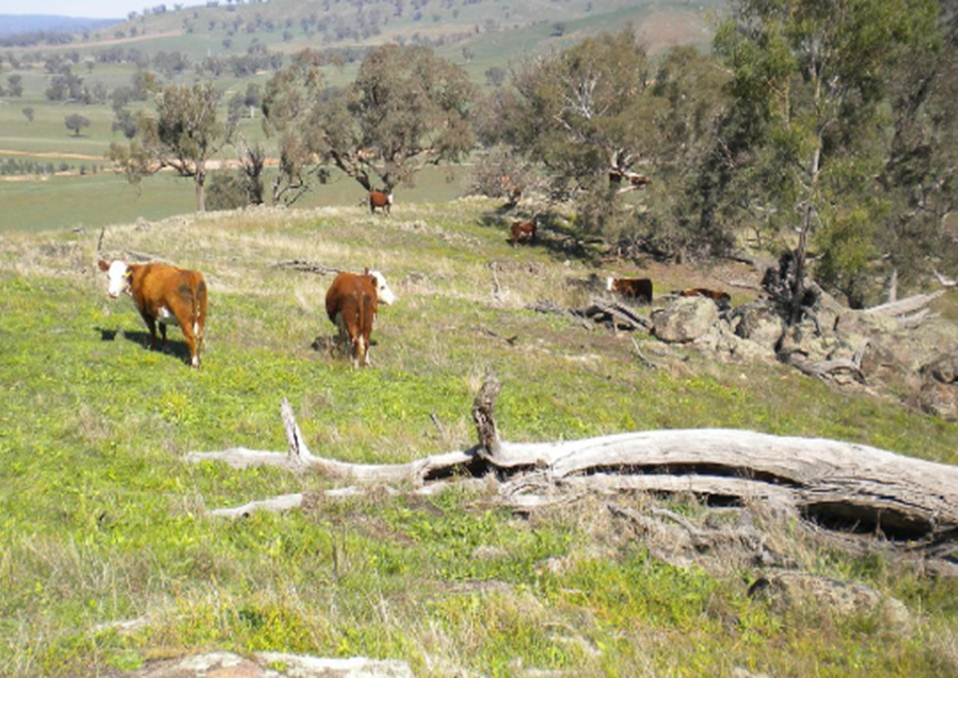
Figure: Healthy landscapes embrace on-farm biodiversity improvement such as increases in native animals in particular threatened species. No questions were asked about changes in biodiversity across farm in terms of areas of revegetation and/or remnant vegetation protection and data about sightings of species.
- What is trend in declared weed presence and feral animal numbers across the farm, e.g. % area growing gorse and blackberry, serrated tussock, Chilian needle grass; programs implemented to control foxes, rabbits?
Instead of these outcomes questions the survey’s next question is about which HL activities you have participated in. Question 11 asks how many HL activities you have participated in. As a result of participation Question 13 asks by how much has HL participation increased awareness about, knowledge of, and skills to implement regenerative land management activities, without giving examples of what regenerative land management activities mean in practice on farm.

Figure: Control and removal of declared weeds is a fundamental component of health landscapes management but no question is asked about trend in area of contaminated land on participants farms and area controlled each year.
Question 14 introduces participants to practices that might be considered associated with regenerative management or best practice livestock, pasture, and soil food web management. But the tick box options are so general as to be meaningless. For instance regarding rotational grazing have you either trialled it, adopted it, improved on existing practice, planning to try or no change. Similarly for adjusting stocking rate which is most likely being confused with and should mean adjusting “carrying capacity” ; managing ground cover; managing pasture diversity; excluding stock from waterways; protecting native vegetation; revegetation; and soil health management.
The consultants analysing the answers will provide councils with a host of data along the lines of the percentage of participants ticking each of the options without having any idea of outcomes actually contributing to healthy landscapes across the shires involved. There will be a percentage of participants who have adopted all the best practices listed but still the survey consultants will have no idea what the adoption rate means for healthy landscapes.
Such a survey is not a one off, it is the basis for most farming practice and farm ecosystem management surveys. Data about on-farm practice outcomes from major land/ecosystem management organizations such as landcare networks, catchment management authorities is usually limited to numbers of participants in funded programs and projects rather than outcomes for the ecosystem under the land owners control. In an era when climate change is the nation’s and world’s greatest environmental threat, how many shires participating in HL know the number of landholders who have climate neutral farms or who are heading towards climate neutral via CO2 abatement in revegetation and soil carbon projects. The HL program aims don’t include reducing farm greenhouse gas emissions or CO2 abatement.
The reality is that the organisation(s) that fund programs like HL don’t care about outcomes they care about a perception that the program has sufficient participants who tell the survey consultants what they think the funder(s) wants to know for future publicity and on-farm ecosystem management greenwash. Question 15 is typical “ Thinking about the practices you have trialled or implemented, how much influence did Healthy Landscapes have? Options are a great deal, quite a lot, some, a little, none. It’s a leading question which the consultants know will most likely elicit a positive answer.
Question 17 ask about changes the participants have observed on their properties across a range of topics with the answer options all anecdotal. Even the topics asked about are so general in nature as to be meaningless, for instance “Pasture diversity” has it improved a lot, improved somewhat, improved a little, etc Even if participants had sufficient knowledge of pasture species to identify them, the answer options provide no insight into achieving healthy landscapes. Pastures can be grown with a host of outcomes in mind based on land owners farming objectives. For instance a bent grass, Yorkshire fog, sweet vernal, silver grass, rough dogs tail, pasture might be diverse, but is highly unproductive in terms of dry matter grown per hectare per year, but it is also quite sustainable in terms of year round ground cover and soil organic carbon percentage when the livestock carrying capacity objective is less than 6 dry sheep per hectare or there is no commercial imperative involved in owning livestock other than keeping pasture levels down for property neatness or fire control (lifestyle farm owners).
Similarly with the other long-term outcomes asked about. Without data the anecdotal outcomes “improved a lot”, “ improved somewhat”, “improved a little” etc are meaningless. How is person meant to differentiate between “a lot”, “somewhat”, “ a little” compared to measured percentages of grasses, legumes, herbs and their different species?

Figure: Soil testing for nutrients and pH is critical for developing and maintaining desirable multi-species pasture components including clovers which not only support livestock productivity but aid in reduction of methane gas emissions and supply a natural source of nitrogen for grasses to utilise and assisting a farm’s ability to achieve a climate neutral status.
While all the long-term outcomes questions are meaningless some are ridiculous, for instance it asks for an assessment of livestock health/condition over the long-term. What are the criteria for health – internal parasites egg counts, external parasites treatments, death %, condition score at joining, weaning etc, none are mentioned?
Like question 15, question 19 about the impact of HL on changes made on the property. It’s a leading question as participants are unlikely to state they wasted their time and money attending the program and tick either “not at all” or “no changes observed”. Because participants have not been asked for any data around changes made as result of HL program, they have no basis on which to base impacts other than personal perceptions of change.
Take home message
The Healthy Landscapes program survey results are unlikely to provide participating councils with any data around farm ecosystem health across their shires. It will provide a host of feel good messages about participants perceptions of outcomes. If the majority of perceptions are positive then the program will be hailed a success despite having no evidence from participants properties that any improvements have happened since 2021 across grazing management, grazing productivity, soil health, biodiversity, and waterway health. As for reducing on farm greenhouse gas emissions and increasing carbon abatement in vegetation and soil they seemingly are not a component of healthy farming landscapes!
A relevant message about the inadequate approach taken by the Healthy Landscapes program and its participants survey was outlined in a September 2026 Farmers for Climate Action webinar where Professor Matthew Harrison reviewed a major research paper “Costs of transitioning the livestock sector to net-zero emissions under future climates”. His conclusions from the five year, $4.1million dollars research investment apply to all healthy landscapes:
- Carbon farming is just good practice. Improving soil organic matter is conducive to improved soil carbon, improved water holding capacity, improved animal health improves liveweight gain and substantially reduces enteric methane.
- Climate smart management improves drought resilience and stores carbon.
- Document stewardship improvements (satellite imagery, livestock inventories, soil carbon, conservation, tree planting) because these records may become important in the future.

Figure: CO2 abatement through private revegetation plantings or Clean Energy Regulator carbon farming projects is not mentioned as a component of the Heathy Landscapes program
US 1000 farms program
A US regenerative agriculture program Ecdysis 1000 Farms is demonstrating what the Healthy Landscapes program is missing – measuring outcomes on participating farms. The Ecdysis mission states “We seek to test the potential of regenerative agriculture by serving as a scientific voice that generates empirical evidence and shares it through education, partnerships, and on-site demonstrations.
“We are collecting and analyzing biometrics of agricultural systems to produce farm-level data and demonstrate how management practices affect the ecological health of the land. Each producer receives a Grower Report of their farm’s data to learn about the health of their land and how it compares to other farms in the region”, Ecdysis states.
The participants find out how their farming practices are improving ecosystem and productivity outcomes with data provided from annual measurements taken by Edysis volunteers, young scientists.
“This enthusiastic bunch isn’t there to tell you how to grow crops or animals. ‘Knowledge speaks, but wisdom listens’. They want to hear your stories and see your farm, they want to hear how long you’ve been farming, why you farm, how and where you sell the food you are growing.
“Their interest, their questions, their patient listening, offer you hope because you realize that someone actually cares about the effort you put in to produce
the food that feeds your family, your community and, ultimately, the world.
“Stories told, the attention of these young scientists shifts. They are here for serious business. They hammer stainless steel probes into your soil, sweep the foliage of your field with insect nets, measure the vegetation–both crop and weeds–covering the soil, scan the field margin and fencerow for the presence of birds. The data they collect will tell about the health of your farm, adding to the picture they are painting of agriculture, not just its current practice but how it could be practiced in the future”.
The Healthy Landscapes program has a blue-print to follow in the Ecdysis 1000 Farm grower reports. But this is not new. Having participants recording their own “Action Plan Check-list, Monitoring and 5 year summary” as per a revised VFF Environment Management System work book developed in Victoria in the early 2000s would be a good start. A basic self-audit could be a condition of participation in HL and would be far more cost effective and likely to be undertaken by landowners who own it compared to using third parties even when the data is collected at no charge as per the Ecdysis model. The not-for-profit Ecdysis Foundation relies on donations to support its monitoring program which it estimates costs around US$8000 per farm per year.

Infographic: The Ecdysis Grower Reports are a blue-print the Healthy Landscapes program should adopt with adjustments to suit Victorian farming environments, farm greenhouse gas abatement and emissions, and climate change outcomes.

Figure: Monitoring impacts of management on farm ecosystem health and productivity began in the early 2000s with Environment Management System programs. Without any incentive to undertake holistic monitoring provided in an EMS they were abandoned by landcare/CMAs, state governments and farmers themselves in favour of short-term, feel-good programs like HL. The latest incentive approach carbon credits and nature repair credits only provides for new initiatives while incurring high monitoring costs leaving the last 40 years of on-farm ecosystem improvement outcomes going unrecognized.
*Appendix: The Healthy Landscapes – Practical Regenerative Agricultural Communities (PRAC) is being delivered as a partnership between: